
 ~15 min
Inscription in Midnight stays very close to the profession players already know, but that does not make it a shallow craft. It still covers a wide spread of outputs, including staves, off-hands, profession tools, Darkmoon cards, upgraded trinkets, sigils, contracts, missives, Vantus Runes, treatises, reagents, and House Decor. Because of that range, Inscription can work as both a practical utility profession and a long-term market profession, depending on how you build it.
One of the main strengths of Inscription is that it does not lock you into one single end product. You can use it to support raiders and dungeon players through Vantus Runes and missives, support the wider profession economy through treatises and reagents, or move into crafted weapons and off-hands through the Blueprint side of the profession. That flexibility gives it good long-term value, but it also means your early point placement matters. If you spread your points too thin, the profession stays broad but weak. If you pick a direction early, it becomes much easier to turn that breadth into something useful.
How Midnight Inscription Fits Into the Expansion
Midnight Inscription is one of the easier crafting professions to level to max, but that does not mean the profession is simplistic. The leveling route is forgiving compared to some other crafts, yet the real value of the profession only appears once you start using its specialization trees properly. Inscription is much more about what you want to make at max level than about fighting a difficult 1-100 route.
That makes the profession feel different from many others. Instead of spending the whole leveling process worrying about whether you can even reach the next skill bracket, you can think earlier about what part of the profession you want to build around. Do you want crafted weapons and tools? Do you want to focus on contracts, missives, and Vantus Runes? Do you want a setup centered on Darkmoon cards and the trinkets tied to them? Inscription gives you those different routes early enough that the profession feels shaped by your destination more than by the leveling grind itself.
What Changed for Inscription in Midnight
Midnight does not completely redesign Inscription, but it does introduce a few important changes that affect materials, Darkmoon cards, and long-term profession progression.
Only Two Quality Levels
Materials and consumables used by Inscription now come in only Silver and Gold quality. Like other Midnight professions, this removes the old three-rank clutter and makes quality management easier. It also means you can think more clearly about when you are pushing for Gold quality and when Silver output is acceptable.
Darkmoon Decks Work Differently
Darkmoon crafting is one of the most important Midnight changes for Inscription. Scribes can now craft stronger, spark-based Darkmoon trinkets, while the base deck is assembled from collected cards and exists as a lower item-level version anyone can equip immediately.
Cards still drop from mobs, but Inscription no longer relies only on outside card drops. Scribes can also convert inks and Thalassian Essence of the Faire into Darkmoon cards, which should make the base decks easier to assemble than in older systems. That matters because Darkmoon crafting is no longer only about hoping the outside market supplies the raw cards. Scribes now have a more direct role in feeding that system themselves.
Moxie Replaces the Old Shared Currency
Inscription now uses its own profession currency: Artisan Scribe’s Moxie. Like the other Midnight professions, this replaces the old shared profession-currency model. Your Inscription currency now stays tied to Inscription-specific progression and purchases, which makes the profession more self-contained than before.
Epic Profession Gear
Midnight also expands profession gear quality. Green and blue profession gear can move through the normal player economy, while epic profession pieces are bind-on-pickup and go through work orders. These do not require Moxie, but they still matter once you start caring about stronger profession performance rather than only reaching max skill.
Core Materials, Milling, Pigments, and Inks
Inscription lives and dies on its material chain. The profession starts with herbs, turns them into pigments through Milling, then turns those pigments into inks and later reagents, missives, contracts, and higher-end crafts. Because of that, the profession’s real cost is not just “buy herbs and craft something.” The real cost is how efficiently you move through every stage of that chain.
The supplied material specifically connects herbs, pigments, and inks in a very direct way. For example, Thunderspice mills into Thunderspice Pigment, which is used for Sienna Ink. Likewise, Sanguithorn mills into Sanguithorn Pigment, which is used for Munsell Ink.
This is why the material side of Inscription matters so much for build planning. If you are buying all of your herbs and also buying your processed reagents, then you are depending on the market twice: once at the herb stage and again at the reagent stage. If you mill and craft your own pigments and inks, you gain more control, but that also pushes you toward the processing side of the profession trees. In other words, Inscription is not only about what final item you want to sell. It is also about how much of the reagent chain you want to own yourself.
Where to Learn Inscription
The Midnight Inscription trainer is Tethras, located on the eastern side of the Bazaar in Silvermoon City, north of Murder Row. This is where you begin the profession and return for the core trainer side of the setup.
Waypoint: /way Silvermoon City:Eversong Woods 47.69 53.80
Like several Midnight profession trainers, this location matters mostly because the early profession flow stays centered in Silvermoon before spreading out into zone vendors, renown rewards, and knowledge-tree unlocks.
How to Level Inscription Efficiently
Inscription is one of the easiest crafting professions to level to max in Midnight. That is one of the reasons you do not need to obsess over the leveling route as much as you would for some other professions. The real challenge is less about “can I hit 100?” and more about “what do I want to be good at once I get there?”
The supplied guide makes this point clearly: you only need a few more expensive crafts near the end to reach 100, so Inscription gives you more freedom to think about your max-level build instead of treating leveling as the main obstacle. That makes the profession a strong candidate for players who want a relatively smooth climb into a broad and useful crafting endgame.
50-90: Vantus Rune and Treatise Route
Once you reach 50, you can learn Vantus Rune: Radiant. The recommended route is to craft one for the profession knowledge, then continue crafting treatises until level 90. The treatise recipes turn yellow at 80 and green at 90, which makes them a practical bridge through this large middle bracket.
The guides specifically recommend stopping around 90 rather than grinding treatises far past that point, unless you actually need more of them. By then you should generally have enough treatises for your own characters, and the final stretch is better covered through new recipes from Moxie vendors or specialization unlocks.
90-100: Finish Through Tree Recipes or Vendor Recipes
At level 90, the profession shifts away from simple repeat crafts and into the part of the system that really defines Midnight Inscription. You either buy new recipes from the Moxie vendor or unlock them through the specialization trees, then use those crafts to cover the final 10 levels to 100.
This is one of the cleanest examples of why early planning matters. Since the last stretch is meant to be finished through the part of the profession you actually care about, your Knowledge direction is directly tied to your leveling finish.
Inscription Specializations in Midnight
Midnight Inscription has four main specialization trees, and they divide the profession into broad stat support, crafted weapons and tools, commodity-style products, and Darkmoon crafting. That spread is what makes Inscription feel flexible instead of locked into a single product type.
- Calm Hands;
- Blueprints;
- Perfect Products;
- Darkmoon Curiosity.
Calm Hands
Calm Hands is the best starting point for almost every Inscription build because it supports your crafting stats across the whole profession. It is also the tree that unlocks Thalassian Treatise on Inscription, which is one of the profession’s most useful weekly Knowledge tools.
That makes Calm Hands much more than a passive stat tree. It improves the efficiency of everything else you do and gives you access to one of Inscription’s most practical long-term crafts. If you are not sure where to begin, this is the safest first step because it keeps the rest of the profession stronger no matter which second or third tree you choose later.
Blueprints
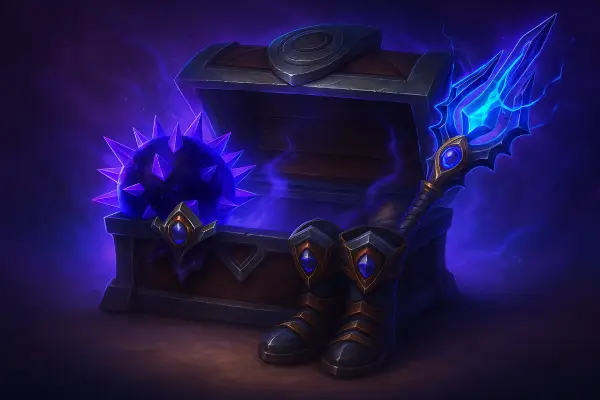
Blueprints is the weapon and tool side of Inscription. It splits into a left side focused on crafted combat items like staves, bows, and off-hands, and a right side focused on profession tools. This is the natural route if you want Inscription to make gear and equipment rather than mainly contracts, missives, or commodity products.
The profession guide specifically points out that the amount of points needed to maximize all of the tool paths is very high, which makes it an expensive route if you try to do too much at once. In practice, that means the smarter play is usually to invest early in the pieces that many players actually want — most notably caster staves and off-hands — instead of trying to become a universal tool crafter immediately.
Perfect Products
Perfect Products is the commodity and reagent-focused tree. This is where Inscription turns into a stronger market profession centered on Contracts, Missives, Vantus Runes, and the internal reagent chain that supports them.
This path is especially useful if you want to sell not just final products, but also better-quality pigments, inks, and ciphers. The supplied guide makes a clear point here: you will never be able to make rank 2 reagents out of rank 1 materials, so the order in which you improve your reagent chain matters. The recommended sequence is to first reach rank 2 pigments, then rank 2 inks, and finally rank 2 ciphers. That logic shows why Perfect Products is not just a “sell commodities” tree. It is also the profession’s reagent-quality and process-efficiency tree.
Darkmoon Curiosity
Darkmoon Curiosity is the card and deck side of the profession. This is the tree that unlocks the four Darkmoon card lines and the stronger items tied to them. If you want Inscription to build around cards, trinkets, and sigils, this is the specialization that gives the profession that identity.
It is also one of the profession’s more distinctive routes because it turns Inscription into something closer to an endgame gear-support profession rather than only a commodity producer. Darkmoon crafting is not just another side recipe category in Midnight — it is one of the main reasons to take the profession seriously if you want more than contracts and missives.
Recommended Starter Inscription Builds
The supplied materials outline two strong starting routes. Both assume you already followed the leveling path and placed 10 points into Calm Hands first. After that, the profession branches based on whether you want crafted gear and tools or whether you want commodity crafts and reagent quality.
The Blueprints Build
The Blueprints Build is focused on weapons and profession tools. Since endgame players regularly use crafted weapons and off-hands, and since profession tools matter especially early in an expansion, this route is aimed at work-order value and crafted-equipment relevance.
The recommended path is to unlock Blueprints as your second specialization, then open Field Research, and from there go immediately into Staves. Putting 15 points into Staves teaches two staff recipes, which gives you your first practical crafted items for Patron Orders and the final push toward level 100.
After that, you choose whether you want to focus on weapons first or profession tools first. If you stay on the weapon route, the guide recommends spending 15 more points in Field Research to open another sub-specialization, then choosing Lamps and Lanterns and placing 15 points there to learn an off-hand recipe. The logic is simple: off-hands are expected to be more popular than bows, so they are the better early item target.
If you want tools, the path continues by filling out the main Blueprints wheel and then unlocking Market Research, where 30 points teaches all three profession tool recipes. From there, the build opens up and your remaining points can go wherever best supports your long-term goals.
The Perfect Products Build
The Perfect Products Build is focused on Contracts, Missives, Vantus Runes, and improving your own reagent production. This is one of the strongest early-market routes because it supports both reagent quality and auction-house commodity output.
The guide starts this route by still taking Blueprints second, but only lightly, because you need a good Patron Order recipe first. You unlock Field Research, then Staves, and put 5 points into Staves to learn a staff recipe. That gives you a practical early order craft without committing fully to the equipment side.
After that, you unlock Perfect Products as your third specialization. Since this tree does not immediately teach new recipes, the route begins by putting 30 points into the main wheel to open both sides of the tree. From there you unlock Perfect Missives and Perfect Milling.
At that point the build splits depending on whether you want to buy your reagents or process them yourself. If you want to be self-sufficient, you first fill the Processing wheel and open Perfect Inks and Perfect Ciphers. Then you max Perfect Milling so you can produce better pigments, followed by the ink path so those pigments turn into stronger inks. After that, you return to the parchment side of the profession and fill the Parchment wheel to unlock Perfect Contracts and then Perfect Vantus Runes.
The guide also specifically recommends filling out Dextrous Diligens in Calm Hands for strong multicraft support, then moving into Keen Eye for better material returns. That pairing makes this build especially strong if you want Inscription to behave like a refined commodity profession instead of a gear-focused one.
Darkmoon Cards, Decks, Dominion Trinkets, and Sigils
Darkmoon crafting is one of the most distinctive parts of Midnight Inscription. Cards can still drop from mobs, but Scribes are also able to produce them through their own profession loop, which makes the system less dependent on outside luck than it used to be.
Once you collect all 8 cards of a suit, you can combine them into a deck. The deck itself is a usable trinket at a lower item level, so it already has some value on its own before any further crafting happens.
Darkmoon Dominion Trinkets
A Scribe can then upgrade the deck into a higher-end Darkmoon Dominion trinket. These recipes all come from the Darkmoon Curiosity specialization, and non-Scribes can still use the work order system to have one crafted for them.
Recipe | Source |
|---|---|
Darkmoon Curiosity | |
Darkmoon Curiosity | |
Darkmoon Curiosity | |
Darkmoon Curiosity |
Darkmoon Sigils
Darkmoon Sigils are optional reagents that add embellishment effects to crafted gear. They require a full deck to craft, which means they sit in a slightly different market position from the trinkets themselves. Instead of being direct gear pieces, they interact with the embellishment system and give Scribes another way to turn Darkmoon crafting into value.
The profession materials also note that players can only wear up to two embellished items at a time, which is important context for how these sigils fit into gearing decisions.
Contracts, Treatises, Missives, and Vantus Runes
This part of the profession is where Inscription becomes much more than a “Darkmoon card craft.” Contracts, treatises, missives, and Vantus Runes are some of the profession’s most practical outputs because they support progression across a much broader player base.
Contracts
Contracts are a classic Inscription utility craft, but Midnight keeps them relevant by tying them to the expansion’s renown factions. You can only sign one contract per week, and the effect is shared across your Warband, which makes them useful but not endlessly stackable.
Contract | Source |
|---|---|
Renown 5 vendor in Zul'Aman | |
Renown 5 vendor in Harandar | |
Renown 5 vendor in Eversong Woods | |
Renown 5 vendor in Voidstorm |
Treatises
Treatises remain one of the most practical cross-profession crafts in Midnight. Inscribers craft Thalassian Treatises for every profession, while also using Thalassian Treatise on Inscription weekly for their own Knowledge Point gain.
The source material specifically notes an extra detail here: if you fully unlock the Calm Hands specialization, your own Inscription treatise gives an additional Knowledge Point. That means the treatise side of the profession is not just a universal utility craft for others — it also scales back into your own specialization choices.
Missives and Vantus Runes
Missives and Vantus Runes sit at the center of the Perfect Products route because they are both classic Inscription outputs and because they connect directly to better reagent quality. The guide positions this category as one of the strongest early profit opportunities, particularly if you can reach better pigments, better inks, and then stronger ciphers before many other players do.
That relationship is important. The value here is not only in selling the final rune or missive. It is also in being able to control the quality of the reagent chain that leads into them.
Where Inscription Knowledge Points Come From
Knowledge Points are a major part of Inscription progression in Midnight. You gain one point every time you craft a new recipe for the first time, and then continue building your weekly progress through profession systems layered on top of that. Because Inscription is relatively easy to level, these Knowledge sources matter even more, since they are what turn a max-level Scribe into a specialized one.
Weekly Knowledge Sources
Source | KP | Details |
|---|---|---|
Weekly Quest | 3 | Trainer weekly source. |
Patron Crafting Orders | 16 | Main weekly Knowledge source for the profession. |
Repeatable Treasures and Drops | 4 | Includes items such as Brilliant Phoenix Ink and Loa-Blessed Rune. |
Thalassian Treatise on Inscription | 1-2 | Thalassian Treatise on Inscription gives 1 weekly Knowledge Point, or 2 if Calm Hands is fully unlocked. |
One-Time Knowledge Sources
Inscription also has strong one-time sources that help push you into a real build much earlier than weekly systems alone would.
- Profession Treasures — 8 total treasures across Midnight zones, worth 24 Knowledge Points altogether;
- Faction Profession Knowledge — once you reach Renown 6 with Hara’ti in Harandar, you can buy 10 Inscription Knowledge from Naynar for 75 Artisan Scribe’s Moxie and 750 Voidlight Marl;
- Darkmoon Faire — monthly, but still important, granting 3 Knowledge Points and +2 skill through a short profession quest.
Catch-up System
Inscription also has a catch-up system through Patron Orders. If you fall behind, they reward Flicker of Midnight Inscription Knowledge instead of Glimmer of Midnight Inscription Knowledge. Once you catch up, the reward flow switches back again.

Profession Equipment for Scribes
Inscription also crafts and uses profession equipment, and this matters more once your build direction is already established. Like the other Midnight professions, green and blue profession equipment can move through the normal player economy, while epic pieces go through the work order system. These do not require Moxie, but they do matter if you want stronger crafting performance over time.
The Blueprint side of the profession also includes the three profession-tool recipes Inscription can make for itself, Alchemy, and Cooking. That gives the profession another niche outside of personal gearing and commodity products: it can also function as a profession-equipment supplier.
Best Race and Best Profession Pairings
All races work fine for Inscription, but there are a couple of minor profession-related bonuses worth noting.
- Nightborne — +5 Inscription skill through Ancient History;
- Kul Tiran — +2 to all profession skills through Jack of All Trades.
The best profession pairing is usually Herbalism, because it lets you gather your own herbs for Milling and the rest of the reagent chain. Alchemy is also a practical alternative because it shares the same herb-based resource pool and gives good overlap if your second profession is meant to use similar materials rather than gather them.
Making Gold With Inscription
Inscription has strong gold-making potential in Midnight because it can convert relatively cheap base materials into a wide range of more valuable outputs: runes, missives, Darkmoon Sigils, crafted weapons, profession tools, and other utility products. That does not mean every category will stay profitable forever. Commodity markets are usually the first to get saturated, and missives or runes can end up only marginally more expensive than the materials used to make them.
What keeps Inscription attractive is the depth of its talent trees. Different Scribes can end up serving very different markets. Some will go into commodity products, some into weapons and off-hands, some into profession tools, and some into the Darkmoon system. Until your skill, gear, and Knowledge are fully built out, you will often depend on Concentration to guarantee maximum-rank output, which means daily production can cap quickly. The supplied material specifically suggests alts as a way to increase production capacity while the profession is still highly profitable.
FAQ
Is Inscription hard to level in Midnight?
No. The supplied guides describe it as the easiest crafting profession to level to max, even though some of the final crafts can be expensive.
What is the best first Inscription specialization?
Calm Hands is the safest first choice because it improves your crafting stats across the profession and unlocks Thalassian Treatise on Inscription.
What is the best build if I want weapons and tools?
The Blueprints Build is the recommended route for crafted weapons, off-hands, and profession tools, starting with Field Research and Staves.
What is the best build if I want missives, contracts, and Vantus Runes?
The Perfect Products Build is the stronger route for that, especially if you also want better control over pigments, inks, and ciphers.
What professions pair best with Inscription?
Herbalism is the most natural pairing because it supplies your herbs directly, while Alchemy is also a good option because it shares the same material pool.