
 ~9 min
Every hero in Marvel Rivals belongs to one of three roles: Vanguard holds the frontline, Duelist deals the damage, and Strategist keeps the team alive and enabled. Simple on paper, and yet role misunderstanding loses more games than bad aim ever will, because Marvel Rivals has no role queue: nothing stops a team from running five Duelists, which means every lobby's composition is a negotiation, and the player who understands all three jobs holds the advantage in it. This guide explains what each role actually does, the archetypes inside each one, the composition templates that work, and which role to pick for your goals.
The Three Roles at a Glance
Role | The job | Profile | Roster share | Easy first pick |
|---|---|---|---|---|
Vanguard | Create and hold space: absorb attention, control ground, open fights | Biggest health pools in the game, roughly 500 to 1,000 HP, with damage mitigation and crowd control built into every kit | 13 heroes | Groot |
Duelist | Convert space into eliminations: burst, flank, and finish targets | Damage-focused kits, mostly self-serving abilities, the widest range of playstyles in the game | 27 heroes | The Punisher |
Strategist | Keep the team online: heal, enable, and swing fights with utility | Less damage than Duelists, less health than Vanguards, and some of the most powerful ultimates in the game | 12 heroes | Rocket Raccoon |
One roster oddity worth knowing: Deadpool is the only hero who flexes across all three roles, with a form in each. Everyone else lives in one role permanently, and the depth comes from the archetypes within each role rather than from switching between them.
No Role Queue: What Open Selection Really Means
Marvel Rivals does not lock roles. Your team can run six Vanguards, five Strategists and a Duelist, or any other shape, and you can swap heroes freely at spawn or between deaths. That freedom cuts both ways:
- Composition is everyone's job. There is no system guaranteeing you a tank or a healer, so reading the team screen and filling the hole is a skill the game quietly demands of every player. The single most common lost game below Diamond is the one where nobody would play frontline.
- Mid-match adaptation is always available. Being countered is never a life sentence; the swap at spawn is free. Teams that re-draft against what the enemy is running win fights they were losing, and most players below high ranks never use the tool.
- Stacked comps are legal, not good. The game is balanced around role synergy, and a team with no healing or no frontline is playing a structural handicap no amount of aim compensates for.
Vanguard: The Space Creators
Tanking in a hero shooter is not standing still and absorbing damage; it is deciding where the fight happens. A Vanguard walking forward with support behind them moves the entire battle line, and a Vanguard who falls usually surrenders the ground the team was standing on. Every kit in the role carries two signatures: damage mitigation, through shields, barriers, walls, or oversized health pools, and crowd control, a stun, root, or knock-up that turns a target into an opportunity.
The role splits into two archetypes:
Archetype | How it plays | Examples |
|---|---|---|
Frontline anchor | Limited mobility, excels at holding positions and walling off ground. Stands literally in front of the team and makes walking past miserable | Groot, Doctor Strange, Magneto, The Thing |
Dive tank | Mobile disruptors who jump the enemy backline, soak attention there, and force the enemy Strategists to heal themselves instead of their team | Venom, Thor, Bruce Banner |
The role's classic mistakes have classic fixes. Walking forward alone because you are tanky is not tanking, it is donating: move on your team's tempo, inside your Strategists' line of sight. Chasing a low-health target into the enemy backline trades won space for a coin-flip kill; if they ran, you already won the ground, so hold it. And a dead Vanguard protects no one, so treat survival as the job description rather than the constraint on it.
Duelist: The Space Converters
Duelists carry the simplest mandate and the widest toolbox: turn the space your Vanguard creates into eliminations. The role holds over half the roster, and its internal variety is the real subject to learn:
Archetype | How it plays | Examples |
|---|---|---|
Ranged poke | Sustained pressure from behind the frontline, punishing anyone who peeks | The Punisher, Hela |
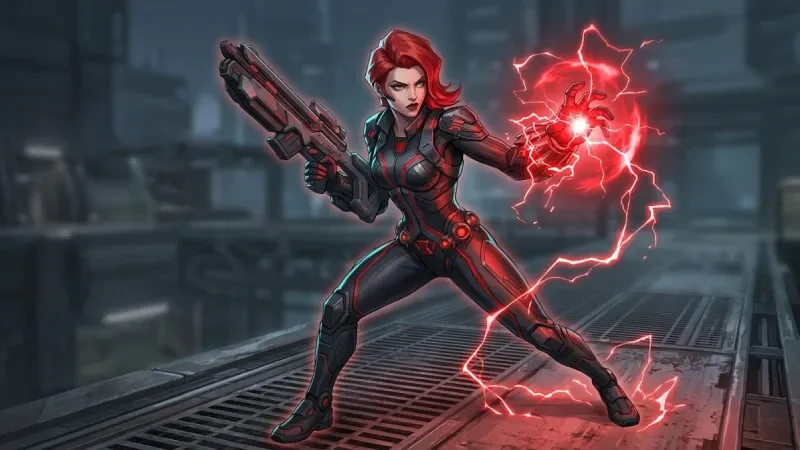
Snipers and long range | Pick threats that control whole sightlines | Hawkeye, Black Widow |
Flying ranged | Vertical angles the enemy has to dedicate attention to answer | Iron Man, Storm |
Flankers and divers | Mobile assassins who enter through side angles and delete backliners | Spider-Man, Black Panther, Magik |
Melee and frontline | Brawlers who fight inside the scrum, near their Vanguard | Iron Fist, Wolverine |
Two principles separate contributing Duelists from scoreboard decorations. First, play off angles: standing directly behind your Vanguard means every shot your team fires comes from one direction, and one enemy barrier mitigates all of it, so a Duelist ten meters to the side makes the enemy defend two directions at once. Second, secure kills instead of farming damage: damage poured into a healed target does nothing but charge the enemy Strategists' ultimates faster. The elimination is the product; the damage is just the process.

Strategist: The Timing Controllers
Strategist is the most misunderstood role in the game and, in the current Season 9 meta, arguably the most impactful: with time-to-kill fast across the roster, healing throughput and utility decide which team is still standing when the dust settles. But healing is only half the kit. The role's utility layer, resurrections, damage amplification, crowd control, and battlefield-swinging ultimates, is what wins matches, and the role carries some of the strongest ultimates in the game precisely because a support ultimate can reverse a lost fight outright.
Three habits define the good ones:
- The oxygen mask principle. Take care of yourself first, because a dead Strategist heals nothing and a Strategist who survives a dive keeps the whole team online. Position with cover and a retreat path, not just distance.
- Triage by win condition, not by volume. The correct healing target is the player holding space or converting a kill, not whoever is loudest or lowest. Support is a decision-making role wearing a healing skin.
- Stagger your cooldowns. Dumping every defensive tool at the first pressure leaves nothing for the enemy's real commit. One major tool held in reserve wins the second wave of the fight, and the second wave is where fights are decided.
Strategists are also far from helpless: many carry real damage or crowd control and win 1v1s against careless divers. The July 11 hotfix made the role even more fight-defining by raising healing-to-ultimate-energy conversion from 60% to 70%, speeding up the support ult cycle across the board.
Team Compositions That Work
With no role queue, comp templates are conventions rather than rules, but the conventions exist because they win.
Template | Shape | When to run it |
|---|---|---|
Standard 2-2-2 | 2 Vanguards, 2 Duelists, 2 Strategists | The default. Covers space, pressure, sustain, and objective presence; the safest shape at every rank |
Fortified | 2 Vanguards, 1 Duelist, 3 Strategists | When the enemy cannot break your sustain: extremely hard to kill, wins long objective holds |
Dive | Mobile Vanguards plus flanker Duelists | Against immobile backlines: overwhelm the enemy Strategists before the enemy setup matters |
Poke into brawl | Ranged core that collapses forward on a pick | On long-sightline maps where your ranged heroes win the opening exchange |
Whatever the template, the floor is fixed: at least one real frontline and two healers. Below that floor, comps do not lose to better players, they lose to their own structure. Which specific heroes fill each slot best right now is the job of our Season 9 tier list, and the Team-Up loadout system adds a cross-role layer on top, since the strongest comps also stack pairings that upgrade each other's abilities.
Save -20% on your boost ⚡

The Classic Mistake in Each Role, and the Fix
Every role has failure patterns so common they are practically uniforms. Recognizing yours is worth more rank than any hero swap.
Role | The mistake | The fix |
|---|---|---|
Vanguard | Walking forward alone because the health bar allows it | Move on the team's tempo, inside your Strategists' sightline; a tank nobody can heal or follow is a donation, not an engage |
Vanguard | Retreating in a panic and giving up won ground for free | Cycle corners deliberately: take one, absorb pressure, reset behind it, retake it. Retreat is a maneuver, not an escape reflex |
Duelist | Taking first contact for the team | That is the Vanguard's job, done without Vanguard tools. Enter after the frontline engages, from an angle the enemy is not watching |
Duelist | Pouring damage into healed targets | Damage that does not convert charges the enemy supports' ultimates. Switch targets, coordinate the focus, or force the healers first |
Strategist | Standing in the open because "behind the team" felt safe | Distance is not safety; cover and a retreat path are. Rotate early rather than perfectly |
Strategist | Dumping every cooldown at the first sign of pressure | Stagger resources and keep one major tool for the enemy's real commit; the saved cooldown wins the second wave |
A pattern worth noticing: every one of these mistakes is a player importing another role's instincts into their own. The Duelist tanking, the Vanguard fleeing like a support, the Strategist positioning like a sniper. Role mastery is mostly the discipline of doing your own job while the fight tempts you to do someone else's.
Which Role Should You Pick?
- New to hero shooters: start Strategist. The mechanical bar is lower, the team impact is enormous, and the role teaches you to read the whole battlefield, which transfers to everything else. Rocket Raccoon in particular plays like a familiar shooter while you learn.
- Coming from tactical FPS games: start ranged Duelist. The Punisher's kit rewards existing aim immediately while the ability layer sinks in.
- Natural shot-caller: Vanguard. The role decides where fights happen, so if you like leading engagements, tanking is the closest thing to steering the match.
- Climbing solo queue: learn one and a half roles. A main role with two or three heroes plus a serviceable fill pick in another, because from Gold III up the ban phase punishes narrow pools and lobby role gaps punish inflexibility. The point math behind that is in our climbing guide.
- Playing with a regular duo: pair complementary roles. Vanguard plus Strategist or dive Duelist pairs win coordinated fights that random lobbies cannot answer.
How the Three Roles Fit Together
The cleanest mental model in the game: fights are won with space, timing, and conversion, and each role owns one of the three. Vanguards decide where the fight happens. Strategists decide how long their team gets to fight it. Duelists decide what it costs the enemy. A team coordinating all three looks mechanically better than it is; a team missing one is quietly playing a role down no matter how the scoreboard reads.
That is also why role collapse loses games invisibly. A Duelist who keeps taking first contact is doing a Vanguard's job without Vanguard tools. A Vanguard who never walks forward forces the Duelists to buy space with their health bars. A Strategist who only heals hands the enemy every timing decision in the match. When a game feels lost for no visible reason, one of those three collapses is usually the reason, and knowing all three jobs, even for roles you never queue, is how you spot it. It is also, not coincidentally, how the ladder's better players read your team; the ranked system that rewards them for it is covered in our Competitive system guide.

FAQ
What are the three roles in Marvel Rivals?
Vanguard is the tank role: the biggest health pools in the game, damage mitigation, and crowd control, responsible for creating and holding space. Duelist is the damage role, over half the roster, responsible for converting that space into eliminations. Strategist is the support role: healing, utility, resurrections, and some of the strongest ultimates in the game.
Does Marvel Rivals have role queue?
No. Roles are not locked: a team can run any combination, including six of one role, and heroes can be swapped freely at spawn or between deaths. Balanced compositions are a convention the community enforces, not a system the game does, which makes reading your team screen and filling gaps a core skill.
What is the best team composition in Marvel Rivals?
The standard 2-2-2, two Vanguards, two Duelists, two Strategists, is the safest shape at every rank because it covers space, damage, and sustain at once. Variations work situationally: a fortified 2-1-3 with three Strategists for long holds, or a dive comp with mobile Vanguards and flanker Duelists against immobile backlines. The reliable floor is at least one frontline and two healers.
Which role is best for beginners in Marvel Rivals?
Strategist is the most common recommendation: the mechanical bar is lower than Duelist, the team impact is high, and the role teaches battlefield reading that transfers everywhere. Rocket Raccoon is the classic first pick since his weapon handles like a familiar shooter. Players from tactical FPS backgrounds often ramp faster on a ranged Duelist like The Punisher instead.
Which role has the most heroes?
Duelist by a wide margin, with 27 heroes, against 13 Vanguards and 12 Strategists. That is also why Duelist queue competition is fiercest in open selection, and why players who can flex to Vanguard or Strategist tend to have smoother games: the roster's shape guarantees damage players are never in short supply.
Can one hero play multiple roles?
Only one: Deadpool, who uniquely flexes across Vanguard, Duelist, and Strategist forms. Every other hero belongs to a single role permanently. Variety within a role comes from archetypes instead, like frontline anchors versus dive tanks among Vanguards, or snipers versus melee flankers among Duelists.
Is Strategist or Vanguard more important right now?
Both are structurally required, but in the current Season 9 meta Strategist is arguably the most impactful role: time-to-kill is fast across the roster, so healing throughput decides which team survives exchanges, and the July 11 hotfix raised support healing-to-ultimate-energy conversion from 60% to 70%, speeding up the role's already fight-swinging ultimates.